Why Your Cleaning Station Is the Production Bottleneck (And How to Fix It)
Introduction
How to Recognize the Real Bottleneck
! The Symptoms of a Cleaning Constraint
- • Baskets of dirty parts routinely queue ahead of the washer while downstream stations wait
- • Operators from machining or assembly stand idle waiting for clean parts
- • Overtime is concentrated in the cleaning area, or cleaning runs on extra shifts
- • Parts are routinely released dirty or with skipped cycles to meet deadlines
- • Finished orders miss ship dates even though machining finished early
- • The cleaning area is chronically cluttered and parts are hard to locate
- • Adding more machine tools does not increase plant output
The Bottleneck Test
To confirm the bottleneck rather than guess, measure utilization. Over a representative week, log:
- Total available cleaning time
- Actual cleaning time (wash cycle running)
- Time spent waiting, loading, unloading, transferring, and re-cleaning
- Number of parts or batches completed per shift
If the cleaning station runs near 100% utilization while other stations wait, it is the constraint. A related diagnostic is the throughput ratio: divide the parts the cleaning station completes per shift by the parts the rest of the line produces.
Why Cleaning Becomes the Slowest Operation
Legacy Methods Were Never Built for Modern Throughput
Manual degreasing, soak tanks, and hand-operated spray cabinets are labor-intensive by nature. One worker physically scrubs, hoses, or repositions each part, so output is capped by the speed of human hands. Modern machine tools, meanwhile, have multiplied productivity several times over. The cleaning process was often never upgraded to match.
Hidden Time Loss Inside the Cycle
Even where mechanical cleaning exists, much of the perceived cycle time is not actually cleaning:
Under-Sized or Under-Powered Equipment
A washer that was adequate at yesterday’s volumes becomes a choke point as the business grows. Common problems include tanks too small for current parts, weak ultrasonic power that requires long cycles, single tanks that handle wash, rinse, and drying sequentially, and missing automation that forces constant operator attention.
Calculating the Throughput You Actually Need
How Ultrasonic Cleaning Lifts Throughput
Faster, Parallel, Hands-Off Cleaning
An industrial ultrasonic cleaner attacks the bottleneck on several fronts at once. Cavitation cleans every wetted surface simultaneously, including blind holes and complex geometries, so a complete basket reaches the same standard in 5–15 minutes that might take an hour or more by hand.
Replacing Sequential Stages with Parallel Flow
The biggest throughput gain often comes from process layout rather than the wash itself. A multi-stage system arranges dedicated tanks in sequence so a new batch enters the wash tank as the previous batch moves to rinse and the one before that dries. Instead of one batch taking the full sequence time, the line completes a batch at the pace of the single longest stage.
Practical Bottleneck-Busting Measures
Right-Size the Machine
Choose tank capacity and ultrasonic power for the actual workload. Verify effective ultrasonic power density rather than trusting nominal wattage.
Optimize Loading and Fixtures
Custom baskets and fixtures increase both usable capacity and cleaning consistency. A well-designed fixture lets an operator load a full batch in seconds.
Standardize Parameters
Set and document frequency, temperature, detergent concentration, and cycle time. Digital control machines make these settings repeatable.
Keep the Bath Ready
Add filtration to remove particles, oil skimming to separate grease, and top-up routines to maintain concentration.
Ultrasonic cleaner TS series
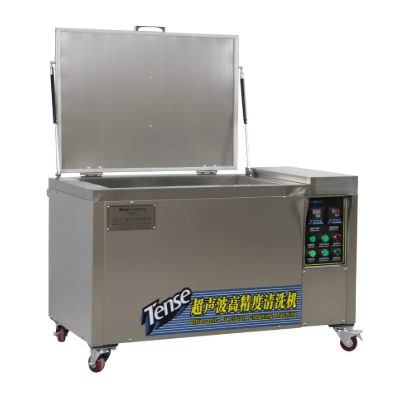
Short Description:
Conclusion
When parts wait for cleaning while the machines that made them sit idle, the cleaning station is not just a nuisance—it is the operation setting the maximum output of your entire plant. The remedy is not to push operators harder but to eliminate the structural mismatch.
If cleaning is pacing your plant, share your current throughput and part dimensions with Tense for a capacity-matched system layout and cycle-time calculation.
FAQ
Q: How do I calculate the required ultrasonic cleaning cycle time?
A: Start from takt time: divide available production minutes per shift by the number of batches required per shift. Each batch’s full wash–rinse–dry handling must complete within that takt.
Q: Will a bigger single tank solve my bottleneck?
A: Sometimes, but often not. If your constraint is the total sequence time or manual stage-to-stage transfer, a multi-stage line that overlaps batches usually delivers far more throughput.
Q: How much faster is ultrasonic cleaning compared to manual degreasing?
A: Workshops commonly report ultrasonic cycles of 5–15 minutes per basket replacing 30–60 minutes or more of hand cleaning.