Ultrasonic Cleaning vs. High-Pressure Spray Washing: Which Is Better?
When engineers evaluate industrial parts cleaning methods, ultrasonic cleaning and high-pressure spray washing are the two most common options. Both remove oil, grease, and particulate from manufactured components — but they work through fundamentally different mechanisms and excel at different applications. This comparison breaks down performance, cost, throughput, and suitability across common industrial use cases.
How Each Technology Works
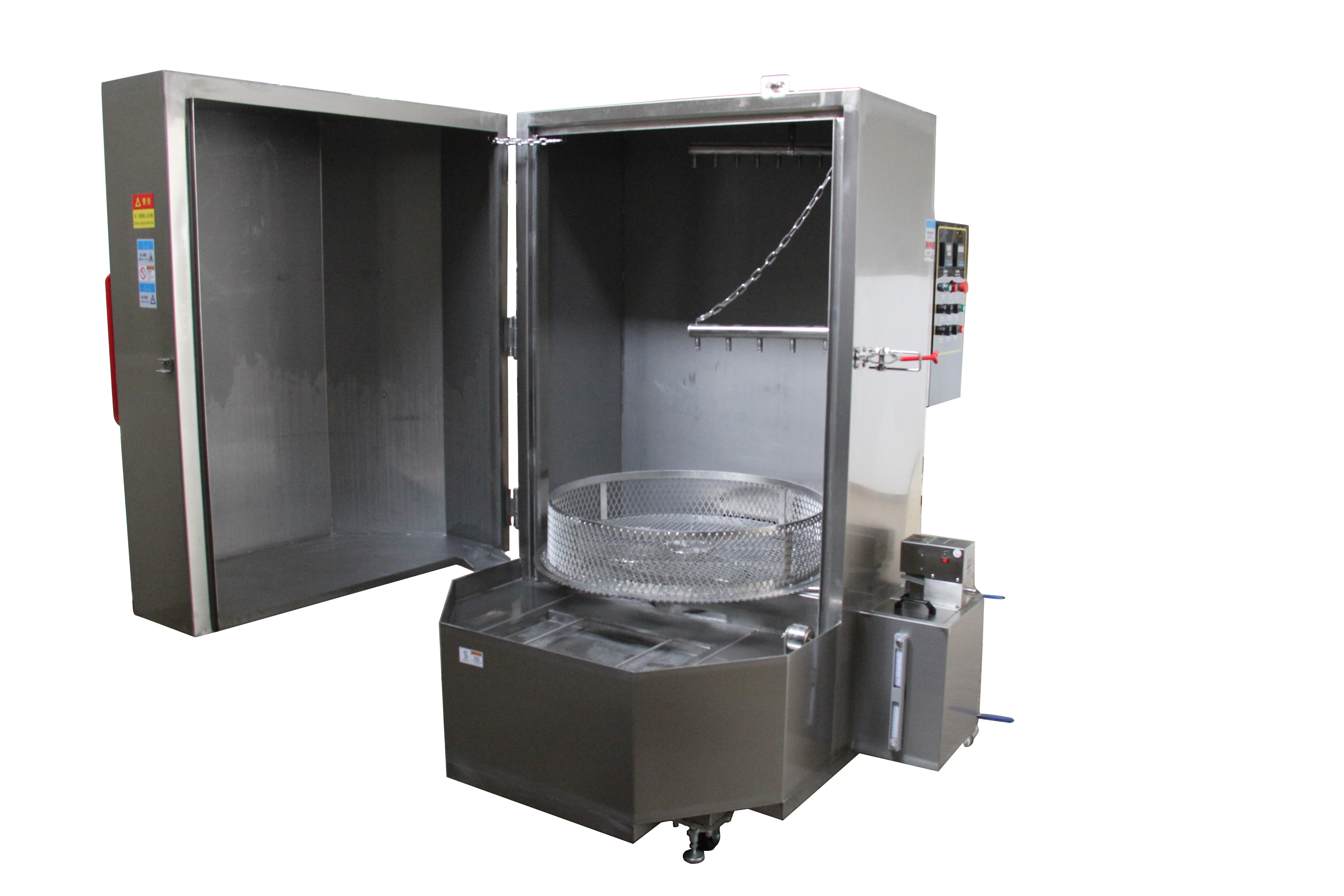
Spray washers (also called cabinet washers or jet washers) direct high-velocity streams of heated detergent solution at parts through fixed or rotating spray nozzles. Cleaning is achieved through mechanical impingement — the force of the spray physically blasts contaminants off surfaces.
- • Pressure range: 30–300+ bar (400–4,000+ PSI)
- • Typical temperature: 50–80°C
- • Mechanism: Mechanical impact + detergent chemistry
- • Line-of-sight only: Only surfaces directly hit by spray get clean
Model
TS-P800 Dimension (mm) 1500 x 1360 x 1900
Max cleaning part’s size(mm) φ800x H1000mm
Load capacity (kgs) 200
Rated Power(Kw) 17
Heating power ( Kw) 11.0
Cleaning pressure (Bar) 4.5
Pump power 5.5kw
Tense TS Series Ultrasonic Cleaning
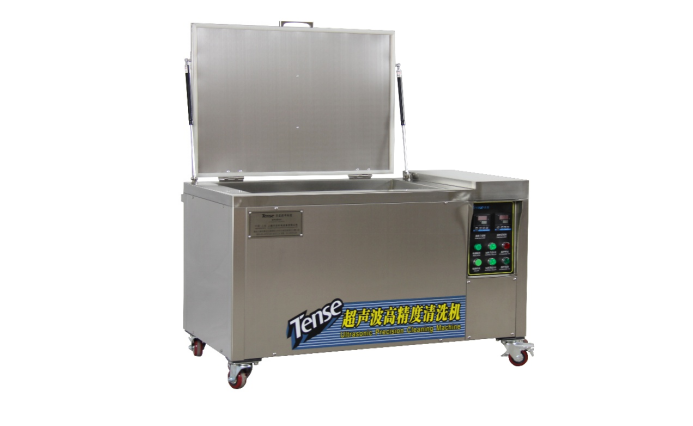
Ultrasonic systems use high-frequency sound waves to create cavitation bubbles in a liquid bath. These bubbles implode on all submerged surfaces, producing microscopic scrubbing action that reaches every crevice.
|
Model |
TS-3600A |
TS-4800A |
TSD-6000A |
TSD-7000A |
TSD-8000A |
| Dimension (mm) |
1460 x 1240 x 920 |
1680 x 1220 x 970 |
1880×1440×1100 |
2300×1800×1460 |
2600×1950×1600 |
| Volume(ltr) |
308 |
430 |
780 |
1147 |
1600 |
| Tank size (mm) |
1000×550×560 |
1200×600×600 |
1400×800×700 |
1700×900×750 |
2000×1000×800 |
| Useful size (mm) |
920×510×420 |
1170×560×490 |
1260×690×560 |
1530×730×580 |
1860×860×680 |
| Heating (KW) |
10.0 |
10.0 |
22.0 |
22.0 |
30.0 |
| Ultrasonic power(KW) |
1.8 |
3.5 |
5.3 |
12.0 |
16.0 |
| Transducer Qty. (pcs) |
40 |
60 |
96 |
128 |
200 |
- •Cleaning pressure (Bar):
- • Typical temperature: 50–65°C
- • Mechanism: Cavitation + detergent chemistry
- • 360° coverage: Cleans every submerged surface, including internal passages
Head-to-Head Comparison
1. Internal & Complex Geometry Cleaning
This is the biggest differentiator between the two methods.
Spray washing: Only cleans what the spray pattern hits. Internal passages, blind holes, undercuts, and shadowed areas remain contaminated. Rotating parts and multi-axis nozzle arrays help but never fully solve the line-of-sight problem.
Ultrasonic cleaning: Reaches every surface in contact with liquid — deep inside oil galleries, coolant passages, threaded holes, and complex castings. If liquid can get in, cavitation can clean it.
Winner: Ultrasonic cleaning — especially for parts with internal geometry.
2. Heavy Soil & Bulk Contamination
For thick grease, heavy carbon, and large amounts of loose swarf:
Spray washing: High-pressure spray excels at blasting off bulk contaminants. High flow rates carry away large volumes of removed soil quickly.
Ultrasonic cleaning: Effective on heavy soils but slower on extremely thick deposits. Pre-soaking or pre-spraying is recommended for heavily soiled parts.
Winner: Spray washing for bulk soil removal; ultrasonic catches up with pre-treatment.
3. Cleaning Consistency & Repeatability
Spray washing: Results vary based on part orientation, nozzle wear, and position in the cabinet. Shadow zones are inevitable. Nozzle clogging causes gradual performance degradation.
Ultrasonic cleaning: Every submerged part receives uniform cavitation energy. Results are highly consistent batch after batch, with minimal variation from loading pattern.
Winner: Ultrasonic cleaning — significantly better repeatability.
4. Water & Energy Consumption
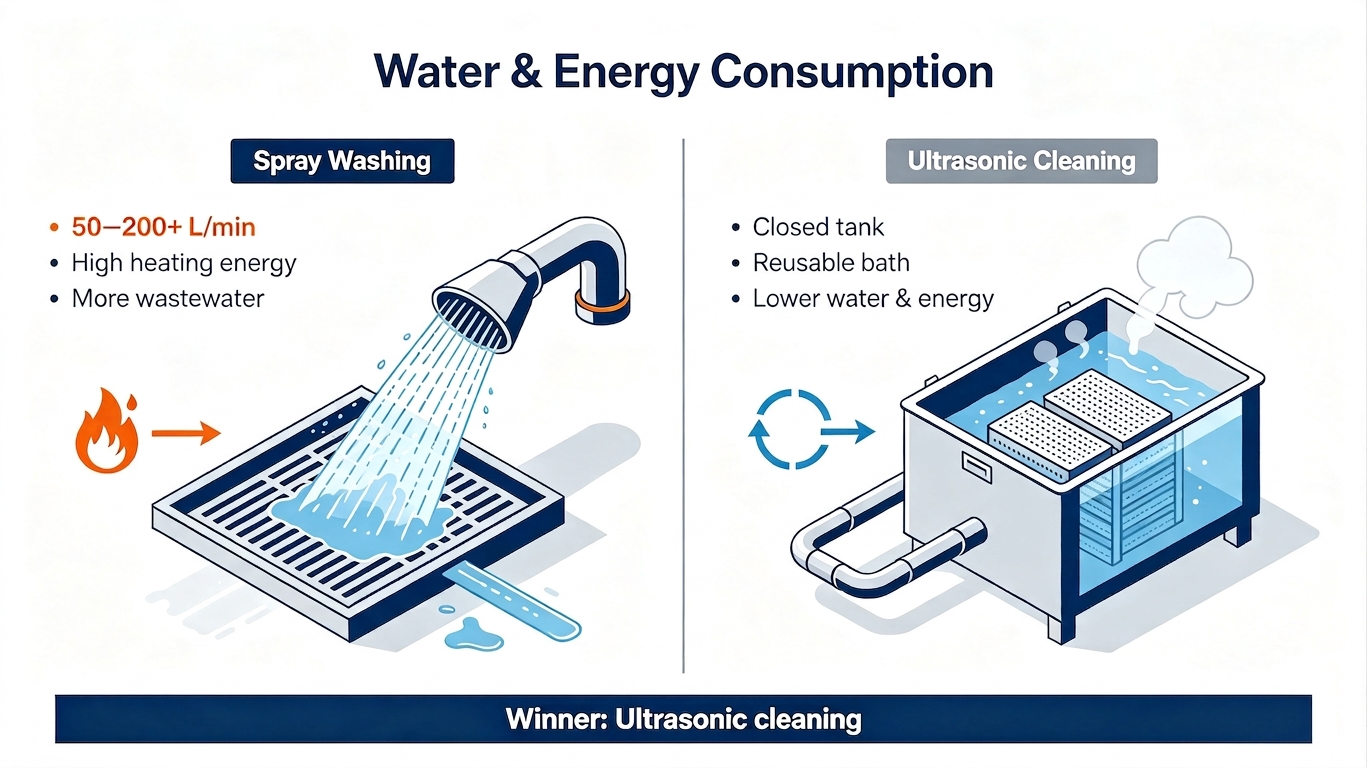
Spray washing: Uses high flow rates — typically 50–200+ liters per minute. Large volumes of heated water mean high energy consumption for heating. Wastewater volume is substantial.
Ultrasonic cleaning: Closed-tank system with minimal water loss. The same bath is reused for many cycles (filtered continuously). Lower total water and energy consumption per part.
Winner: Ultrasonic cleaning — significantly lower water and energy use.
5. Labor & Operator Involvement
Spray washing: Parts must be carefully oriented to expose all surfaces. Complex fixtures and rotation mechanisms add cost. Operators often need to reposition parts or touch up missed areas.
Ultrasonic cleaning: Parts are simply submerged — orientation matters much less. One operator can manage multiple tanks. Cycles run fully unattended.
Winner: Ultrasonic cleaning — lower labor requirement.
6. Part Damage Risk
Spray washing: High-pressure water can damage delicate features, bend thin fins, or drive contaminants into bearing surfaces and seals. Abrasive particles in recirculated water cause erosion over time.
Ultrasonic cleaning: Non-abrasive and surface-safe when properly configured. No mechanical impact force — only microscopic bubble action. Safe for delicate parts and precision machined surfaces.
Winner: Ultrasonic cleaning — gentler on parts.
7. Throughput & Cycle Time
Spray washing: Single parts or small batches can be cleaned quickly (1–5 minutes), but loading/unloading and fixturing adds time.
Ultrasonic cleaning: Cycle times of 5–20 minutes, but large batches are processed simultaneously. Per-part throughput is often higher for batch processing.
Winner: Depends on batch size. Spray wins for single large parts; ultrasonic wins for batch processing.
8. Footprint
Spray washing: Cabinet-style units have a moderate footprint. Multi-stage conveyor washers are very long.
Ultrasonic cleaning: Single-tank systems are compact. Multi-stage lines are modular and can be configured to fit available space.
Winner: Roughly comparable — depends on configuration.
Which Method for Which Application?
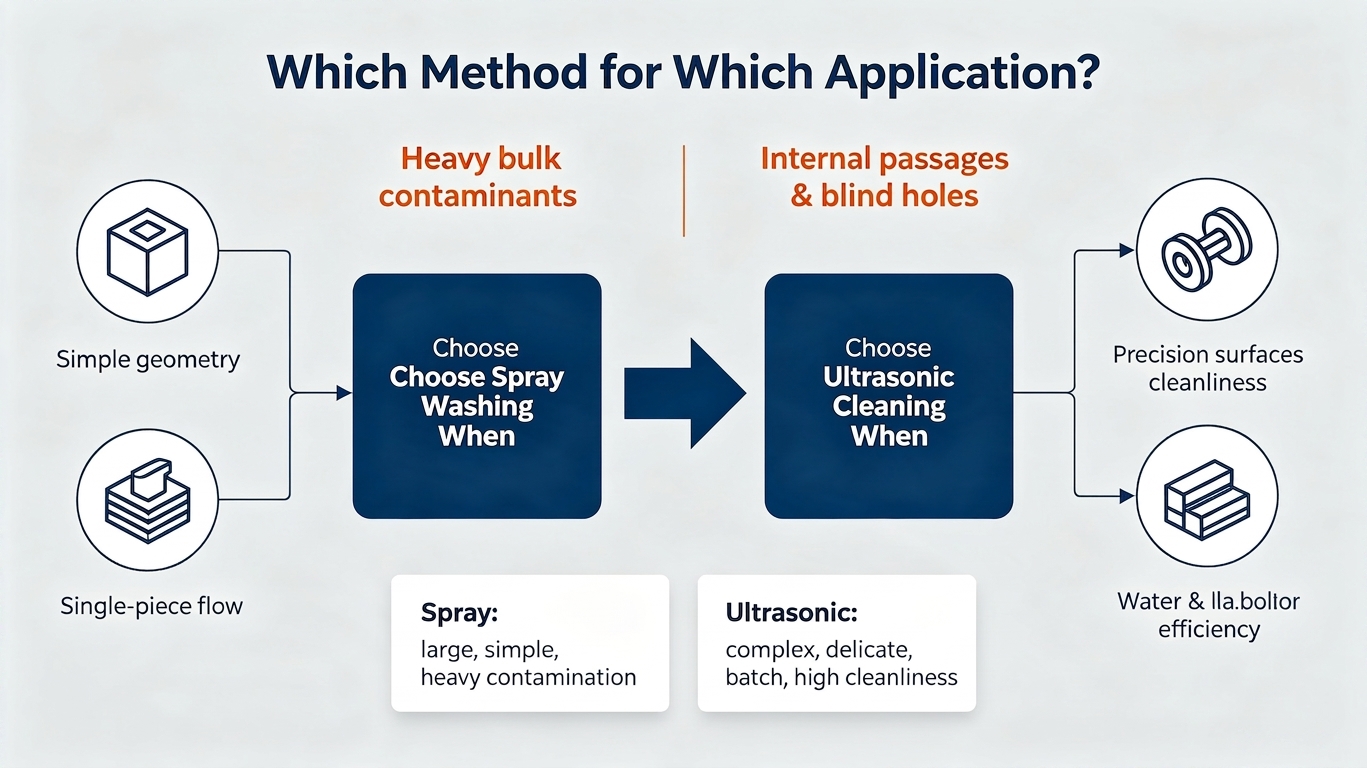
Choose Spray Washing When:
- • Parts have simple, accessible geometry (flat stampings, sheet metal, simple castings)
- • You need to remove extremely thick or bulk contaminants quickly
- • Parts are large and robust enough to handle high pressure
- • Single-piece flow is required rather than batch processing
- • Parts have internal passages, blind holes, threads, or complex castings
- • Consistent, repeatable cleanliness is critical (engine components, hydraulic parts, medical devices)
- • Labor cost reduction is a priority
- • Water and energy efficiency matter
- • Parts are delicate or have precision surfaces that could be damaged by spray
- • You need to meet quantitative cleanliness specifications
Choose Ultrasonic Cleaning When:
Combined Approach: Best of Both
Many production lines use both technologies in sequence: 1. Pre-wash spray station — blasts off bulk grease and loose swarf 2. Ultrasonic wash — precision cleans internal passages and fine details 3. Rinse + dry — final preparation for assembly or coating
This combined approach delivers maximum throughput with the precision cleaning only ultrasonic can provide. Tense designs integrated ultrasonic + spray cleaning lines optimized for each application.
Cost Summary
| Factor | High-Pressure Spray | Ultrasonic Cleaning |
| Initial equipment cost | Medium | Medium-High |
| Water consumption | High | Low |
| Energy consumption | High | Medium |
| Labor requirement | High | Low |
| Consumable cost | Medium (nozzles) | Medium (filters) |
| Maintenance frequency | High (nozzle clogging, pump wear) | Medium-Low |
| Total cost per part | Higher for complex parts | Lower for complex parts |
Conclusion
There is no universal winner — the best method depends on your parts, soil load, and cleanliness requirements. High-pressure spray washing is effective for simple geometry and bulk soil removal. Ultrasonic cleaning delivers superior results for complex parts, internal passages, and applications requiring consistent, repeatable cleanliness.
For many industrial applications, a combined pre-spray + ultrasonic workflow delivers the best overall performance and lowest total cost.
For help determining the right approach for your specific parts, contact the application engineers at Tense Industrial Cleaning machne.