Ultrasonic Cleaning for Bearings: Removing Grease Without Harming Precision
Introduction
Bearings are the most precision-sensitive components in any rotating machine. Their raceways and rolling elements are made to micron-level tolerances, polished to extremely fine finishes, and designed to operate on an extremely thin film of lubricant. When bearings are rebuilt, reworked, or prepared for inspection, the old grease must be removed completely so that wear patterns, pitting, and fatigue can be assessed and new lubricant can perform as designed. But the very process of cleaning can damage a bearing if it is aggressive or careless. This article explains how to clean bearings with an ultrasonic cleaning machine in a way that removes every trace of old grease and particulate while protecting the precision surfaces, and how to carry the bearing cleanly through drying, inspection, and re-lubrication.
Why Bearing Cleaning Is So Demanding
- Aged, oxidized, or hardened grease that has lost its base oil
- Carbon and sludge from high-temperature operation
- Fine metal and abrasive particles embedded in the old grease
- Dust, water, and corrosion products that caused the service problem
- Preservation oils and machining residues on new or reworked bearings
Old grease is deliberately designed to stay in place and resist water and heat—the same properties that make it difficult to remove.
Why Precision Surfaces Need Protection
The rolling elements and raceways of a bearing cannot tolerate damage. The effective lubrication layer in a loaded bearing is only a few micrometers thick, and the smallest dent, pit, or scratch becomes a stress concentration that shortens bearing life. Brushing, scraping, or aggressive blasting can mechanically damage these surfaces, and any abrasive residue left in the bearing will accelerate wear immediately after it is put back in service.
The Bearing Inspection Imperative
Bearings are often cleaned so they can be inspected. A bearing still coated in grease cannot be checked for:
- • Fretting and false brinelling
- • Spalling and fatigue flaking
- • Pitting and corrosion
- • Cage wear and damage
- • Discoloration (overheating)
- • Accurate clearance
How Ultrasonic Cleaning Solves the Problem
Cavitation Reaches Every Bearing Surface
Bearings are densely assembled: rolling elements, cage pockets, and the gaps between inner and outer rings are difficult to access with cloths or brushes. Cavitation does not need to be aimed or brushed into place. As the cleaning solution penetrates the bearing, microscopic bubble implosions occur around the rolling elements, in the cage pockets, and along the raceways, lifting old grease and embedded particles from every contact surface.
The Process Is Gentle and Non-Abrasive
Unlike brushes or blasting media, cavitation does not apply directed mechanical force to precision surfaces. At an appropriate frequency and power, it removes grease without scratching or indenting the polished races. This is the key advantage over hand cleaning: better grease removal with less handling risk.
Ultrasonic Cleaning Supports Rotation
A useful technique during ultrasonic cleaning is to rotate the bearing rings by hand or in a fixture at intervals, which works solution into every rolling contact zone and flushes contaminants out as the elements move around the race.
Choosing the Right Frequency and Power
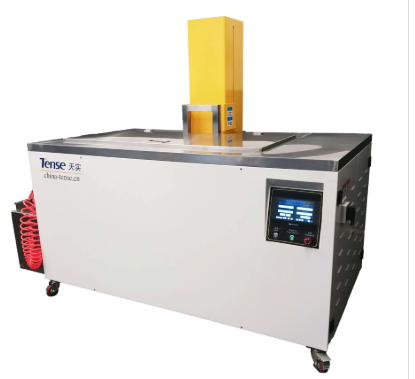
Lift Ultrasonic Cleaner TS-UD Series
Short Description:
Frequency for Bearings
- 40 kHz is the standard general choice for bearings, combining effective grease removal with a gentle action.
- Higher frequencies (80 kHz+) are preferred for small, miniature, or very high-precision bearings.
- 28 kHz should generally be avoided for finished bearing races unless the bearings are large and heavily soiled.
Detergent and Temperature
- Use mild alkaline or neutral detergents (50–70°C).
- Check compatibility for brass, bronze, or polymer cages.
- Aqueous processes require rust inhibitors and thorough drying.
The Bearing Cleaning Procedure
Remove loose surface grease by scraping outside only. Keep sets organized.
Use baskets; avoid tank bottom contact. Run at 40 kHz, 50–70°C.
Flush with clean warm water. Rotate rings during rinsing.
Use DI-water with rust inhibitor or protective oil film.
Use filtered air; NEVER spin dry with compressed air.
Check for damage. Re-pack with correct grease immediately.
Sealed and Shielded Bearings
Bearings with integral rubber seals or metal shields cannot be flushed internally without removing the shields. Most sealed bearings are lubricated for life and should be replaced rather than reprocessed.
Equipment and Process Recommendations
⚙️Industrial Solutions
Large bearings used in heavy equipment require large tanks and fixtures. Tense’s lifting-type TS-UD machines (140 to 2,300 liters) provide the necessary handling and filtration to keep the bath free of abrasive particles.
Conclusion
Bearings reward careful cleaning and punish careless cleaning. Heated ultrasonic cleaning at the right frequency removes old grease and embedded particles from every rolling surface gently and uniformly. Follow a precision operation chain to ensure bearing life and performance.
For guidance on configuring a bearing cleaning workstation, contact Tense with your bearing sizes and throughput.
FAQ
Q: Is ultrasonic cleaning safe for precision bearings?
A: Yes, when configured correctly. Use 40 kHz, moderate power, and support bearings so they never contact the tank bottom.
Q: Can I spin a bearing with compressed air to dry it?
A: No. Spinning an unlubricated bearing at high speed will cause the rollers to skid and score the races, ruining the bearing.
Q: How do I clean sealed or shielded bearings?
A: Most sealed bearings are lubricated for life and should be replaced. Metal-shielded bearings can sometimes be dismantled for cleaning.
Q: What happens if I reuse a bearing without removing all old grease?
A: Residual old grease contains metal and abrasive particles that will continue to wear the races and reduce new lubricant effectiveness.