Sweep vs Fixed Frequency: Dual & Multi-Frequency Ultrasonic Cleaners Explained
Frequency is one of the most important choices in ultrasonic cleaning, but it is not the whole story. Two machines can both claim to operate at 40 kHz and still perform very differently because of how that frequency is delivered. One runs at a rigid, fixed frequency; the other continuously sweeps through a narrow band around 40 kHz. Other machines offer two or more switchable frequencies in a single tank. These distinctions—fixed, sweep, dual, and multi-frequency—directly affect cleaning uniformity, the risk of damaging delicate parts, and how flexible one machine is across mixed workloads. In this article, we explain each technology in plain terms, compare their strengths and weaknesses, and help you decide which frequency control approach your ultrasonic cleaning machine should have.
1 The Basics: Why Frequency Matters
Bubble Size and Cleaning Character
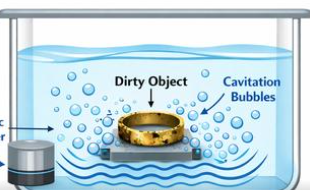
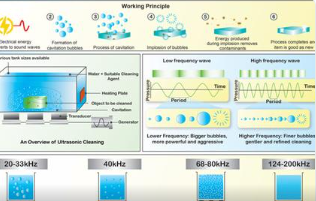
An ultrasonic generator drives transducers that vibrate at a chosen frequency, producing cavitation bubbles that form and implode in time with the sound waves. The frequency sets the bubble size:
- Low frequency (20–28 kHz): large bubbles, violent implosions, strong mechanical scrubbing—ideal for heavy carbon, scale, and burnt grease on durable steel and cast iron.
- Mid frequency (40 kHz): medium bubbles and balanced action—the versatile general-purpose standard for most automotive and industrial work.
- High frequency (80 kHz and above): tiny, dense, gentle bubbles—best for precision parts, soft metals, optics, and fine particulate removal.
Once frequency is fixed, the remaining question is how the generator manages that frequency during operation. This is where fixed and sweep modes differ.
2 Fixed Frequency: Simple and Intense
How It Works
A fixed-frequency generator drives the transducers at a single constant frequency, chosen at manufacture. Every transducer cycles at the same steady rate, and the cavitation field in the tank is static.
Advantages
- Strong, direct energy at the chosen frequency
- Simpler and lower-cost electronics
- Proven for single heavy-duty applications
- Easy to match to specific soils
Limitations
- Standing waves and dead zones: Creates fixed nodes with low energy.
- Uneven results: Requires repositioning of baskets.
- Higher damage risk: Energy concentrates on “hot spots”.
- Single-application focus: Cannot adapt to part mix changes.
3 Sweep Frequency: Uniformity Through Variation
How It Works
A sweep-frequency generator continuously varies the output frequency over a small range (e.g., 38-42 kHz). This shifts the positions of nodes and antinodes, ensuring no spot remains weak or overloaded.
4 Dual-Frequency: Two Machines in One
Dual-frequency machines can operate at two discrete frequencies—commonly 28/40 kHz or 40/80 kHz—switchable by the operator.
When It Makes Sense
- 28 kHz mode: Heavy carbon on pistons and cast iron blocks.
- 40 kHz mode: Everyday mixed automotive and maintenance parts.
- 80 kHz mode: Soft aluminum and precision-machined components.
Multi-Frequency and Broadband Systems
Multi-frequency generators offer three or more selectable frequencies, common in precision manufacturing, medical component cleaning, and electronics.
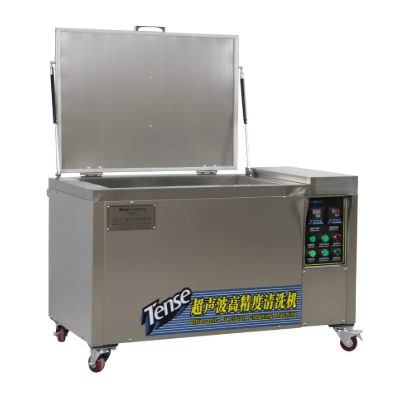
Ultrasonic cleaner TS series
Short Description:
TS series has been specifically designed for the cleaning and degreasing of all type of parts and components in Automotive industry. It achieves excellent cleaning results in many types of materials, especially in complex parts, where the ultrasounds have excellent results thanks to its high penetration capacity. Thus, the results while cleaning automobile engines are spectacular, even in those smaller and delicate parts.
Our Automotive series uses 28 kHz frequency with which the best results for the Automotive Sector are achieved.
5 How to Choose: A Decision Guide
Fixed Frequency If:
- One family of robust parts
- Priority is sustained aggressive energy
- Load is agitated/repositioned
- Simplest reliable budget design
Sweep Frequency If:
- Consistent results across mixed batches
- Cleaning soft metals/finished parts
- Repeatability is a priority
- Quieter operation needed
Dual/Multi If:
- Workload spans carbon to precision
- Single frequency leaves jobs under-cleaned
- Replace two dedicated units
- Need maximum process range
What to Verify Before Buying
- Does the machine offer fixed or sweep mode at each nominal frequency?
- For dual/multi-frequency units, what is the effective power density at each frequency?
- Is frequency switching operator-selectable?
- Can the generator run sweep around each selectable frequency?
- Will the supplier run cleaning trials on your parts?
- What features are standard versus optional?
Conclusion
Frequency is not just a number on a sticker—it is delivered either as a rigid fixed tone or as a continuously swept band. Fixed frequency delivers raw, static intensity suited to dedicated heavy-duty work; sweep frequency trades a small amount of peak intensity for uniform, repeatable, part-safe cavitation.
To match frequency technology to your actual part mix, send your application details to Tense for a configuration recommendation and trial.
FAQ
Q: Is sweep frequency better than fixed frequency?
A: For general and precision cleaning, sweep is usually preferred because it eliminates standing-wave dead zones. For dedicated heavy-duty cleaning of robust parts, a fixed low frequency can deliver the sustained aggressive energy that dense soils prefer.
Q: Do I need dual-frequency or is 40 kHz enough?
A: A single swept 40 kHz machine handles the majority of automotive and industrial jobs. Dual-frequency is worthwhile only if you regularly clean both heavy-carbon steel parts (28 kHz) and delicate parts (60–80 kHz).
Q: Can a dual-frequency machine deliver full power at both frequencies?
A: Not always. Some designs split transducers between frequencies. Always ask for the power density available at each frequency separately.