How to Choose the Right Size Ultrasonic Cleaner for Your Workshop
Introduction
Buying an industrial ultrasonic cleaner is a significant investment, and one of the most important decisions you will make is choosing the right size. Get it right, and you have a machine that handles your parts efficiently and cost-effectively for years. Get it wrong, and you either have a machine that is too small for your needs—forcing you to run more batches than necessary—or one that is so large you are wasting energy and money on capacity you do not use. In this guide, we walk through the factors you need to consider when choosing the size of your ultrasonic cleaner, so you can make a confident decision that matches your workshop’s needs.
Why Size Matters
The Cost of Getting It Wrong
Choosing the wrong size ultrasonic cleaner can be an expensive mistake:
Too small: If the tank is too small for your parts, you cannot clean your largest components at all. Even if you can technically fit the parts, tight quarters reduce cleaning effectiveness by limiting solution circulation and creating shadow areas. You may also end up running more batches than necessary, increasing labor time and energy consumption.
Too big: If the tank is too large, you pay more upfront for capacity you do not need. You also use more electricity, more detergent, and more water per batch. The tank takes up more floor space, and heating a larger volume of solution takes longer and costs more.
The goal is to find the sweet spot—big enough to handle your largest parts and your typical batch size, but not so big that you are wasting resources on unused capacity.
It’s Not Just About Tank Volume
When people talk about the “size” of an ultrasonic cleaner, they usually mean the tank volume—how many liters or gallons the tank holds. But volume alone does not tell the whole story. What matters more is the internal dimensions of the tank—length, width, and depth.
A 100-liter tank that is long and narrow may be perfect for cleaning long parts like crankshafts or rifle barrels, but useless for cleaning wide, flat parts like cylinder heads. Conversely, a tank with the same volume but a wider, shorter footprint may be ideal for cylinder heads but too short for long parts.
Always look at the actual internal dimensions, not just the total volume, when evaluating whether a cleaner will fit your parts.
Step 1: Identify Your Largest Parts
Start with the Biggest
The first and most important step is to identify the largest parts you need to clean. Your ultrasonic cleaner must be able to accommodate these parts—there is no way around it. If your biggest part will not fit, the cleaner is simply not suitable, no matter how good the price or specifications.
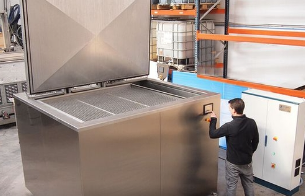
Make a list of your largest or most challenging parts, and note their dimensions:
- Length
- Width
- Height
- Weight
- Any special orientation requirements
Do not just think about the parts you clean today. Think about the parts you might clean in the future. If your business is growing or you plan to expand into new areas, you may want a machine that can handle larger parts down the road.
Account for the Basket and Clearance
When calculating whether a part will fit, remember that you do not put parts directly on the bottom of the tank. They go in a basket that sits a few inches above the tank bottom and away from the walls. You also need space above the parts for the solution level and below the lid.
As a general rule of thumb:
- Bottom clearance: The basket sits 2–5 cm above the tank bottom
- Side clearance: Leave 2–3 cm between parts and the tank walls
- Top clearance: Parts should be 2–5 cm below the solution surface
- Lid clearance: The lid must close fully without touching the parts
So if your largest part is 30 cm tall, you need a tank depth of at least 35–40 cm to accommodate the part, the basket, and the solution level.
Step 2: Determine Your Typical Batch Size
How Many Parts per Batch?
Digital Control Ultrasonic Cleaner
Short Description:
Tense industrial cleaning equipment factory was established in 2005; our cleaning equipment has passed ISO9001 quality system certification, EU CE, ROHS certification. Our cleaning equipment is exported to many countries, and has a long-term cooperative relationship with well-known brands such as Bosch , Caterpillar; Komatsu and other enterprises.
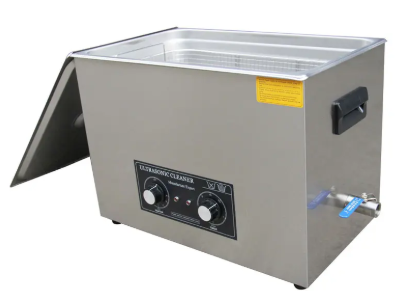
Once you know your largest part will fit, the next consideration is how many parts you want to clean per batch. This determines how much total capacity you need.
Ask yourself:
- How many parts do you clean in a typical day?
- How many batches per day are you willing to run?
- How long is each cleaning cycle?
- Do you need to clean all your parts within a certain time frame?
- You clean 40 pistons per day
- Each cleaning cycle takes 15 minutes
- You want to run no more than 4 batches per day
- 40 pistons ÷ 4 batches = 10 pistons per batch
- You need a basket that can hold 10 pistons with space for solution circulation
The Importance of Not Overcrowding
It can be tempting to cram as many parts as possible into each batch to maximize throughput. But overcrowding the tank actually reduces cleaning effectiveness and can lead to inconsistent results.
When parts are packed too tightly:
- Solution cannot circulate freely between them
- Ultrasonic energy is blocked, creating “shadow” areas
- Parts may rub against each other, causing damage
- Cleaning time increases because the solution cannot reach all surfaces
A good rule of thumb is that parts should occupy no more than 60–70% of the basket volume. The rest should be open space for solution circulation.
Step 3: Consider Your Production Volume
Throughput Requirements
Your production volume—how many parts you need to clean per hour, per day, or per week—will determine whether a single tank is enough or whether you need multiple tanks or a larger system.
Calculate your required throughput:
- Number of parts per day
- Average cleaning time per batch
- Number of batches per day you can run
If a single tank cannot keep up with your volume, you have options:
- Buy a larger tank to clean more parts per batch
- Buy multiple smaller tanks to run batches in parallel
- Add automation to reduce load/unload time and increase cycles per day
Which option is best depends on your specific situation, including your parts mix, available space, and budget.
Growth and Scalability
When choosing size, it is also important to think about the future. Is your business growing? Do you expect cleaning volume to increase in the next 1–3 years?
While you do not want to buy way more capacity than you need today, you also do not want to outgrow your new cleaner in six months. A good rule of thumb is to choose a size that meets your current needs with about 20–30% extra capacity for growth.
If you expect significant growth, consider a modular approach—start with one tank and add another later, rather than buying one massive tank that is underutilized today.
Step 4: Evaluate Your Floor Space
Physical Footprint
Industrial ultrasonic cleaners take up floor space—a lot more than you might think once you factor in access space, parts staging, and auxiliary equipment.
When evaluating size, consider:
- Tank footprint: The actual floor space the machine occupies
- Access space: You need room to load and unload parts, typically 1–2 meters in front of the machine
- Parts staging: Space for dirty parts waiting to be cleaned and clean parts waiting to move on
- Auxiliary equipment: Rinsing stations, dryers, filtration units, etc.
- Walkways: Space for people to move around safely
Measure your available space carefully before you buy. A machine that looks great on paper but does not fit in your shop is useless.
Height Clearance
Do not forget about vertical space. Industrial ultrasonic cleaners can be quite tall, especially when you add the lid and any overhead structures. Make sure you have enough ceiling height and that the machine will fit through any doors or narrow passages on its way to its final location.
Step 5: Factor in Energy and Operating Costs
The Cost of Heating
One of the biggest ongoing operating costs for an ultrasonic cleaner is heating the solution. Larger tanks hold more solution, which means more energy to heat and more energy to maintain temperature.
The energy cost difference between a 100-liter and a 200-liter tank is not just double—it can be more than double because:
- Larger tanks have more surface area for heat loss
- More solution volume means more thermal mass to heat up
- Larger heaters consume more power
If you are running the machine 8 hours a day, 5 days a week, the energy cost difference between sizes can add up to hundreds or thousands of dollars per year.
Chemical and Water Costs
Larger tanks also use more detergent and more water:
- More solution volume means more detergent to fill the tank
- More solution means more frequent top-ups to replace evaporation
- When you change the solution, you dispose of more volume
- Water costs may seem trivial, but they add up over time
Again, the key is to match the tank size to your actual needs. Buying bigger than you need means paying more every time you fill the tank, every time you change the solution, and every day you run the machine.
Common Size Categories and Their Uses
Small Benchtop Units (5–30 liters)
Best for: Small parts, jewelry, electronics, dental instruments, small automotive components like fuel injectors or spark plugs.
Pros: Affordable, portable, low operating costs, fit on a workbench.
Cons: Limited capacity, cannot handle large parts, may not be built for industrial use.
Medium Industrial Units (50–200 liters)
Best for: Most general industrial and automotive applications—pistons, calipers, cylinder heads, transmission components, machined parts.
Pros: Good balance of capacity and cost, versatile, suitable for most workshop applications.
Cons: Take up significant floor space, require proper electrical service.
This is the most common size range for automotive shops and small to medium manufacturing operations. The TS Series from Tense offers several models in this range to suit different part sizes and volumes.
Large Industrial Units (200–1000+ liters)
Best for: Large components—engine blocks, large castings, heavy machinery parts, high-volume production cleaning.
Pros: High capacity, can handle large parts, high throughput.
Cons: High upfront cost, high operating costs, require significant floor space and utilities.
These units are typically found in larger manufacturing facilities, remanufacturing operations, and specialized cleaning shops.
How to Right-Size Your Purchase
The Goldilocks Principle
The goal is to find the size that is “just right”—not too small, not too big. Here is a simple framework:
1. Minimum size: The smallest tank that can fit your largest part with proper clearance.
2. Ideal size: A tank that can handle your typical batch size with room to spare, while also accommodating your largest part.
3. Maximum size: The largest tank you can justify based on volume, budget, and space constraints.
Start with the minimum size and work up. If the minimum size also meets your batch requirements, you have found your sweet spot. If you need more capacity for batch size, move up to the next size.
When to Go Bigger
There are some situations where it makes sense to go bigger than your current minimum needs:
- You expect significant growth in cleaning volume
- You plan to add larger parts to your workload
- The cost difference between sizes is small
- Energy and chemical costs are not a major concern
- You want the flexibility to handle unexpected jobs
When to Stay Small
And situations where staying smaller is better:
- Your volume is stable or declining
- Energy and operating costs are a major concern
- Floor space is limited
- Your parts mix is unlikely to change
- Budget is tight
Conclusion
Choosing the right size industrial ultrasonic cleaner is one of the most important decisions you will make when purchasing equipment. Get it right, and you have a machine that serves you well for years, delivering efficient, cost-effective cleaning. Get it wrong, and you either struggle with insufficient capacity or waste money on a machine that is bigger than you need.
Start by identifying your largest parts and making sure they will fit. Then consider your batch size, production volume, available space, and operating costs. Think about the future, but do not overbuy based on speculation. The goal is to find the sweet spot where the machine meets your current needs with a little room to grow.
If you are still unsure about the right size for your workshop, the experts at Tense can help you evaluate your parts and recommend the optimal tank size and configuration for your specific application.
FAQ
Q: How do I know if my parts will fit in the tank?
A: Check the internal dimensions of the tank (length × width × depth) and compare them to your largest part. Remember to account for the basket, solution level, and clearance—parts should not touch the tank walls or bottom and should be fully submerged.
Q: Is it better to buy one big tank or two smaller tanks?
A: It depends on your needs. One big tank is better for very large parts or large batches of similar parts. Two smaller tanks offer more flexibility—you can run different detergents or temperatures in each, and if one is down you still have the other. For many shops, two medium tanks offer the best balance of flexibility and throughput.
Q: Can I clean parts that are larger than the basket?
A: Generally no. Parts should fit comfortably in the basket with room for solution circulation. Forcing oversized parts into a small basket reduces cleaning effectiveness and can damage the parts or the basket.
Q: How much extra capacity should I buy for future growth?
A: A good rule of thumb is to buy 20–30% more capacity than you currently need. This gives you room to grow without paying for a lot of unused capacity today. If you expect very rapid growth, you may want to consider a modular approach instead of buying one very large machine.